PunkconformityLife, history, and the pursuit of knitting.

Sunday, August 25, 2013

On the needles IV

+ Add a comment
What I'm doing: School started this week, so I have been busy helping students ensure that all is right with their schedules before they are permanently locked.  While our office usually requires that students make an appointment, during the first week of classes we allow walk-ins, which is exciting but very tiring; we can see anywhere from two to eighty students in a single day.

I've also been attempting to fit exercise back into my daily schedule, which is less fun, but probably better for me.  I have a whole rant that I'll make on some other day about how we have produced a society in which it is okay that work take precedence over personal health, and where it is just expected that you will be on the brink of exhaustion almost all the time.  It's really quite horrible, and I'm trying hard to nip my couch-potato-ism in the bud now, but it is an uphill battle (literally and figuratively - the goal for this week is to be able to jog up the hill behind the health center without getting out of breath).

What I'm reading: I just started Ahab's Wife, which is the retelling of Moby Dick from the perspective of the young wife Captain Ahab left behind.  Thus far, I must say I am less than impressed - in the first vignette alone there is a fairly unbelievable description of childbirth, someone freezes to death, and a young slave escapes across the river à la Eliza in Uncle Tom's Cabin (an artistic choice made for no apparent reason at all).  It seems to be a lot of the author saying, "Look how much I know about 19th century literature!" and not enough of the author saying, "Look at this choice I made because it was an integral component of the narrative!"  I know 19th century literature, and you, madam, are no Harriet Beecher Stowe.  At this point, you're not even a passable Emerson.  I'll give it another 50 pages, but unless it gets significantly better, I will be taking this one back to the used book store.

What I'm watching:  We're still in the process of finishing up the last season of Fringe.  I almost don't want it to end, because I have so enjoyed having Joshua Jackson in my life again.  But once that is completed, I think we'll move on to Broadchurch, about which I have heard only amazing things.

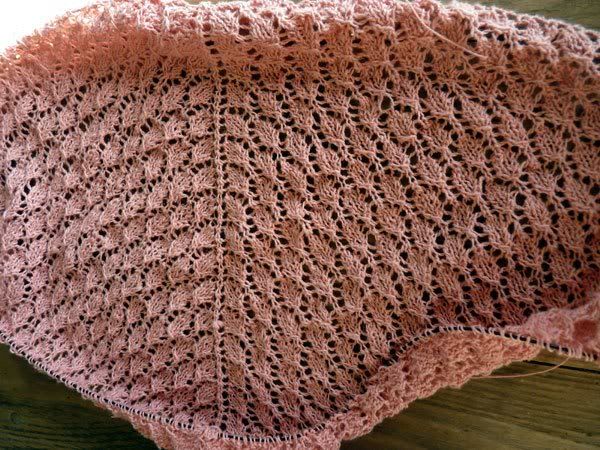
What I'm knitting: The Trimmed with Roses Cardigan, with a few modifications.  I'm knitting in the round to the armholes, and I added two red stripes above the ribbing.  I cannot explain how much I love this yarn, and how beautiful I think this pattern is going to turn out.  I haven't decided if I'm going to do the short-sleeves of the jumper or the long-sleeves of the cardigan - I think it will depend on the amount of yarn I still have when I reach that point.  I might also do fewer buttonholes when I get to the button-band.  We'll see.


Thursday, August 22, 2013

Book Review: Thames: A Biography

+ 1 comment

I love London.  Some might say I am a little obsessed.  My first project as a research assistant was to help design a course that tied early novels to the geography and social structures of London.  So when Peter Ackroyd uses the city (or in this case, the river Thames) as a backdrop for his wild, outlandish, pet theories, I get a little peeved.

I just finished Thames: The Biography, and as the Boy can attest, it left me spitting mad.  Having read several of Ackroyd's other works, I should have known that this would happen, but every time he sucks me in with the promise of interesting anecdotes about my favorite city, and then disappoints me with bad scholarship and poor argumentation.


His particular bug-a-boo in Thames is the idea that the river has been used for religious rites throughout history, and that the modern incarnations of religious houses, commercial buildings, law-courts, etc, that border the Thames are there due to some sort of primordial understanding of the river as a spiritual medium.

Okay, I'll follow you down that rabbit hole, Peter.  What's your evidence?


1) There are lots of churches dedicated to Mary along the river, so that is proof that the river is connected to some sort of ancient fertility goddess.  Huh.  As opposed to the numerous churches dedicated to Mary that aren't along the river?  Somehow those are just churches, but these are tied to internalized remembrances of our ancestors?

2) Lots of the great early modern English astronomer-philosophers lived along the river, which suggests that the flow of the river has always inspired people to look to the heavens and investigate the stars. Sure.  Or, you know, it's darker along the river, because it's a place on which humans find it harder to build things.

3) The existence of henges, cursus, barrows, etc, along the Thames (in conjunction with our modern buildings of power) suggests that for thousands of years, "the Thames remained a sacred and highly charged area." (65) Maybe.  But considering that the most famous henge is on a plain 72 miles to the west, maybe it's just that England is an island, and after multiple thousands of years of human habitation things start to pile up.


He also makes the statement that "London Bridge is Falling Down" was a nursery rhyme dating to the 11th century, when Aethelred the Unready's Viking ally, Olaf, pulled the bridge down with his boats.  The 11th century destruction of the bridge is a highly contested "fact" that is attested only in skaldic verse (which, due to embellishment and generic tropes, has more in common with fiction than with history), and most folklorists agree that the rhyme dates from the 17th century (though it builds on medieval children's games).  So it is extremely problematic that Ackroyd chooses to state these things as absolute fact, with no qualification and no sourcing.

The fact that he includes these unsubstantiated "facts" and makes such poorly substantiated but somewhat titillating arguments suggests to me that he is not confident enough in the significance of his subject matter. He's afraid no one will really care about the Thames qua Thames, that the river only matters to moderns in some larger, Ancient Aliens kind of way, as a gateway to our past beliefs.  He clearly thinks that no matter how tenuous his argument in support of this bosh, it will still be more engaging than an actual history of the Thames.  And that is what makes me the most angry.  The river doesn't need Ackroyd's pet theories to make it more interesting; between 17th century frost fairs, mudlarks, London Bridge actually falling down, Battersea power station, Jerome K Jerome (to say nothing of the dog), the disappearance of the Fleet, Ceasar's incursions into Britain, and all the other amazing things that the river has produced/experienced, why would you ever feel the need to embellish it with bad history and even worse argumentation?

So save yourself the frustration and gnashing of teeth I experienced.  If you're interested in the history of the river and its human inhabitants as they were and are, and not as someone with an obvious ideological agenda wants them to be, read something by a different author.
Monday, July 16, 2012

Notes on a Scandal: My take on the USOC event

+ 1 comment

 I know this is late, but I have to say it.  After the brouhaha that occurred earlier this summer, I wasn't sure I really wanted to participate in Ravel-Greek-Suffix-Which-Happens-to-Also-Be-the-Suffix-in-an-Important-Sporting-Event-s this year.  I admire the athletes, and I appreciate any excuse to wave my Anglophile flag as high as it can go, but the whole thing left a pretty bad taste in my mouth.  While I appreciate what Stephanie said as being fairly logical, I also feel like she missed the point about why at least I, personally, was so outraged.  It wasn't that we had to change the name (although it seems incredibly stupid to me that anyone can "own" a five-letter suffix).  It wasn't even that they said we were denigrating the work of the athletes.  Though that was very, very offensive, I understand that is their standard C&D, and based on their behavior in all other arenas, I wasn't surprised to be denigrated myself by a company who represents the worst of corporate America.  What bothered me the most was how the media commenting on the fiasco spent most of their efforts poking fun at us for being knitters, rather than commenting on the ridiculousness and the injustice of the USOC's claims.  During the whole event, there was only one major article written that did justice to the knitters' side of the argument, and that was on NPR, and even that only really got the point after a knitter commented to correct the initial version of the article.

It bothers me that something that is, for many of us, such an integral part of who we are is still considered by society at large something that makes us odd, bizarre, or objects for derision.  They called us "little old ladies" or "liberal hippie leftists" (conflicted, much?).  They made terrible puns at our expense.  They generally treated our legitimate outrage as a hysterical temper-tantrum by a quaint and clearly unhinged, pre-feminist-movement granny.  Even once the USOC apologized, the tone taken by the media was, "Wow, who knew all those weird old ladies knew how to use social media!"

I am not a little old lady.  I am not a liberal hippie leftist.  I am not denigrating Olympic (can I say that word without permission?) athletes.  And I am not okay with being mocked for what is and was a legitimate complaint against the USOC.


You mock me because I am a knitter, but knitters make, with our own two hands, things that are useful, things that comfort people and keep them warm, things that fit their recipients in a perfect way no high street garment ever will, things that are beautiful.  We make complicated, three-dimensional, intensely mathematical art.  And we do it all with two pointy sticks and some string.

I am a knitter.  I knit in public, in movie theatres and in waiting rooms, at my desk (when I can) and in meetings.  I am not strange or hysterical.  I am not setting the feminist movement back in any way.  I am participating in a proud tradition of hand-crafters that stretches back at least to the 16th century, and in which I am joined by (at the very least) two million people worldwide.

I am a knitter.  What are you?

Saturday, May 29, 2010

"Maybe we should up and leave this town..."

+ Add a comment
It is too hot to knit. At least, that’s the only explanation I can come up with for why took me three weeks to finish Steven’s golf club covers, when it should, by all rights, have taken me three days. We’re trying to save money by not turning on the AC too early, and thus, by the evenings, the temperature upstairs (where I usually do my knitting) more nearly resembles that of the surface of Venus than any place on earth. Now, I’d rather be too hot than too cold, but I’m not going to exacerbate the issue by knitting when my palms are already too sweaty to hold onto the needles. So needless to say, it’s slow going on getting all my knitting-for-other-people out of the way. I think Adin is about to despair of ever getting his mitts.

The woes of house-hunting have come upon me. I am not complaining about having to look for a place – that aspect of the whole experience is wonderful, as it means I am employed, something I could not be more grateful for and excited about. I’m complaining about the fact that it is next to impossible to find a decent place, in a decent neighborhood, with a fenced-in yard. Who knew it would be so difficult to keep big dogs in a part of town that does not have drug-dealers, murders, and thieves? Apparently – according to the rental home industry, at least – only sketchy people have dogs larger than 25 lbs. And supposing you do find a place in a decent part of town that claims to have a fenced-in yard, this is no guarantee that the area that is fenced will in any way resemble a “yard.” I looked at one place the other day with a “fenced-in yard” of – I’m not exaggerating – two feet by two feet. What kind of dog can you keep in that, a tea-cup Chihuahua? But I have until the end of June to have found and moved into a place, so I’m trying to have patience and keep looking.

Something I learned recently: Milk paint is difficult stuff to work with. Or, let me rephrase.It is difficult stuff to use on furniture that has already been painted. It’s hard to get the mix to come out with the right consistency, without lumps, and close to the same color as the previous coats. Even after following the instructions, sanding my side-tables down to almost bare wood and using the extra bonding agent, I’ve still had to put on four coats of the stuff to get it to even remotely resemble paint. The problem may only be that I’m trying to paint something with spindles, which is never easy, no matter the paint, but it’s hard to even get the flat surfaces to come out right. And the thing that bothers me the most about the whole experience is that it cost $30 for a pint of the stuff, and it’s not even coming out the way I want. I feel really bad about wanting to wuss out and use real paint after forking over all that money for the milk paint, but I would also like to get these tables painted some time before I die. It’s a conundrum. I suppose I’ll wait to see how it looks in the morning before I make my final decision.

Here. Have a picture of the puppies to make up for all the whining.


What I'm listening to: "A Little More" by The Audreys
Thursday, February 4, 2010

The Swallowtail

+ Add a comment
There are some patterns out there that are the knitting equivalent of the pop-culture fad - like sorority girls love ugg boots, or scene kids are drawn to neon, there are some patterns that have been made by pretty much everyone interested in that kind of knitting. For lace knitters, that pattern is the Swallowtail Shawl. A complete stranger, upon seeing my Melusine shawl at RenFaire, stopped me to tell me about the Swallowtail she had just completed. She broached the subject confident that I would know exactly what pattern she meant, and I did. At last count there were 6229 completed Swallowtails listed on Ravelry.

It's popular not only because it results in a beautiful lace shawl, but because the pattern is so clearly written out. Fairly often, lace patterns resemble nothing so much as the ramblings of a Japanese lunatic that have been translated into Russian by a French speaker, and then translated into English by a native speaker of Urdu. Some very important details get lost in the translation, and unless you're either extraordinarily brave or a mind-reader, these patterns are not always much fun to attempt. The Swallowtail pattern is not like that. If you follow it line by line, it is as easy as a basic dishcloth pattern. And this is something that everyone comments on. "Oh, start with the Swallowtail for your first lace project. It's so easy!" "You can't go wrong with the Swallowtail, it's so simple!"

Ha, I say, laughing the laugh of the bitter and potentially stupid.

If you do follow it exactly, I'm sure it really is easy. But, supposing, instead of using size 4s and lace-weight yarn, you end up using size 1.25s and some thread-weight cotton of unknown origin, which gives you a gauge of roughly 700 stitches to the inch (okay, so, maybe 25 stitches to the inch, but still...). Then, dearies, the Swallowtail is not easy. It is not simple. It is MATH. And MATH is something we all know that I, as a good History major, loathe.

To illustrate my point: If you should decide to knit more repeats of the body pattern than the 14 that are called for, that's all well and good. Other people have done it, and it turns out fine. But if, and only if, you repeat in multiples of 5. If you knit 19 repeats, or 24, then you're good, and the Lily of the Valley pattern comes out perfectly with no finagling. If, however, you are too stupid to check your math and just pick a random number of repeats and go with it, you will find that nothing will work out right for the next 21 rows.
Supposing, of course, that you manage to catch the first little problem and spend twenty minutes doing the math to determine that the number of stitches you need before you start the Lily of the Valley chart is a little formula that looks like the total number of stitches - 5 border stitches - 34 set up stitches + 4 stitches from the set-up row = a multiple of 10, you are not home free just yet. There is still the problematic matter of the Lace Border chart, which is not worked across a multiple of 10 stitches, but a multiple of 8. So having spent another twenty minutes doing some math, you should realize that you must now have another formula that looks like the total number of stitches - 5 border stitches - 14 set up stitches + 4 set-up row stitches = a multiple of 8. This was a problem for me, as I had increased exactly 100 stitches, resulting in a number that was not a multiple of 8, and could not be a multiple of 8 no matter how hard I willed it to be.

So, in the tradition of all those who have gotten this far into a lace pattern and decided, "screw it, I refuse to rip the bloody thing back again after all this work," I fudged it a little, and did a second "set-up" row in which I increased the necessary stitches evenly across. And now, hopefully, fingers crossed, I can finish the damn thing without having to do any more MATH. Of course, I'm not holding my breath.

I still haven't figured out if the pattern is just not as easy as is claimed, or if I am really just not as smart as most knitters.
Showing posts with label rants. Show all posts